
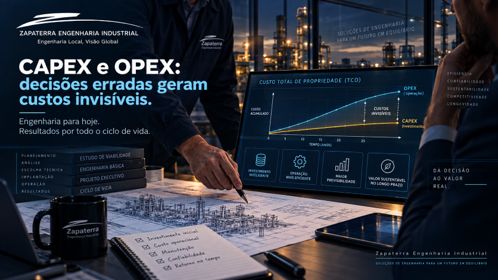
Investment appears in the project. Its consequences continue throughout operation.
In an industrial project, initial investment is naturally an important concern. There is a budget, a limit on available resources, and a real need to implement the installation within the economic conditions of the project.
The problem is not controlling CAPEX. It is assuming that a decision ends when its implementation cost has been paid.
A choice that appears economical today may continue producing consequences for years. Energy consumption, maintenance requirements, equipment availability, accessibility, reliability, component replacement, and even limitations on future modifications remain long after construction is complete.
That is why CAPEX and OPEX should not be seen as two independent subjects, but as different moments of the same engineering decision.
This relationship is not always obvious because the two costs appear at different times. Investment is visible, concentrated, and usually monitored closely during the project. Operating costs appear later, distributed over months or years and often assigned to different teams, budgets, and areas of responsibility.
The distance between a decision and its consequence helps explain why some costs eventually stop being associated with what originally created them.
Future cost can be determined long before operation begins
An installation does not begin consuming energy, requiring maintenance, or presenting limitations only when it starts operating. Many of those characteristics were already conditioned by earlier design decisions.
Equipment sizing, for example, affects how that equipment will operate throughout its service life. The space reserved for maintenance influences every future intervention. The presence or absence of redundancy changes how a system responds to failure. A construction solution may facilitate inspections for decades — or turn every access into a complex operation.
For this reason, a significant part of OPEX may begin to be determined while the project is still being discussed.
Systems operating close to their limits, oversized equipment, layouts that make maintenance difficult, lack of redundancy, and decisions made without considering reliability or lifecycle performance are common examples.
The important point, however, is not to turn any of these situations into an absolute rule.
Oversized equipment is not necessarily inappropriate in every application, just as redundancy is not mandatory in every system. Engineering lies precisely in understanding when a particular characteristic is necessary, what consequences it produces, and what it is worth to avoid or incorporate it.
At that point, the discussion stops being simply about “spending less” or “spending more.”
Savings and cost are not the same thing
One of the most common traps is confusing lower investment with lower cost.
One alternative may require less capital during implementation and still produce higher energy consumption, more frequent interventions, or lower availability during operation. Another may require a higher initial investment while reducing some of those consequences.
Neither option is automatically better for that reason.
The engineering question is different:
What will be the technical and economic behavior of each alternative over the period in which it must perform its function?
This change in the question is important because it prevents CAPEX from being treated as the only indicator of economic efficiency.
At the same time, it avoids the opposite mistake: justifying any additional investment with the generic promise that it will “pay for itself in the future.”
A responsible decision must show which benefits are expected, why they exist, and under which conditions they will actually occur.
The balance is not found by always choosing the cheapest solution or the most sophisticated one. It comes from understanding what each choice delivers, what it requires to continue operating, and which risks it transfers to operation.
Invisible costs rarely arrive under that name
When an inadequate decision produces consequences after implementation, the company rarely receives an invoice labeled “design error.”
The cost arrives in other forms.
Energy appears on the monthly bill. An intervention appears as corrective maintenance. Lack of availability becomes production downtime. Poor access requires additional labor hours. Lack of flexibility becomes visible years later, when a new requirement must be implemented. A component with recurring wear becomes part of the normal maintenance history.
Over time, these expenses can become incorporated into routine operation and eventually be perceived simply as natural characteristics of the installation.
Costs created by an earlier decision begin to be treated as “normal operating costs.”
That is what makes some costs truly invisible.
Not because they are not recorded, but because the relationship between the present expense and the decision that originally created it is no longer traced.
And when that relationship disappears, part of the organization’s ability to learn from it disappears as well.
Applied engineering is making consequences visible before they happen
A sound CAPEX and OPEX analysis does not need to predict every future expense with absolute precision. In many situations, that would not even be possible.
The objective is different: identify which decisions have relevant consequences throughout the lifecycle and bring those consequences into the decision-making process while there is still an opportunity to choose.
This is where criteria such as total cost of ownership, energy efficiency, reliability, maintainability, impact of failures, and future flexibility become relevant.
But these criteria create value only when connected to the actual problem.
Reliability does not carry the same weight in every application. One hour of downtime may be almost irrelevant for one system and critical for another. Future flexibility may be essential in a plant that undergoes constant changes and far less important in an installation with a very stable function.
Once again, the answer is not a ready-made formula.
It lies in understanding the context.
This may be one of the most important functions of applied engineering: transforming future consequences — still absent from the implementation budget — into criteria that can participate in the decision today.
The problem also lies in the separation between project stages
There is another structural difficulty. The people who design, purchase, execute, maintain, and operate an installation do not always participate in the same decision.
One team may be pressured to reduce investment because its responsibility ends when the project is approved. Another team later receives responsibility for operating what was delivered.
If the success indicators of one stage do not consider what will happen in the next, it is natural for some decisions to be optimized locally and become problems for the system as a whole.
This is why lifecycle thinking is not simply a matter of performing more sophisticated economic calculations.
It also means connecting decisions that are normally separated by the organization of the project itself.
When decision-makers can see the impact on those who will execute, maintain, and operate the installation, CAPEX stops being an isolated target and becomes one variable within a more complete engineering decision.
A good decision does not look for the lowest number
Imagine two solutions capable of performing the same function.
One requires a lower initial investment but demands more maintenance and provides lower availability. The other costs more to implement but reduces some of those consequences.
There is no correct answer without understanding the application.
If downtime has little impact, the first solution may be perfectly rational. If a shutdown interrupts a critical process, the analysis changes.
If the difference in energy consumption is small relative to the expected service life, it may not justify additional investment. If the system will operate continuously for decades, that same difference may acquire much greater relevance.
This is precisely why technical decisions should not be reduced to economic slogans.
Low CAPEX is not necessarily good. High CAPEX is not necessarily better. Low OPEX should not be pursued at any cost either.
What matters is understanding the relationship between investment, performance, risk, and service life for that specific application.
Before deciding how much to spend, we need to understand what we are buying
Perhaps this is where engineering and economics truly meet in an industrial project.
It is not enough to ask how much it costs to purchase equipment or build an installation.
We need to understand what behavior that decision will produce after the purchase: how much it will require to operate, what conditions it will require for maintenance, what the consequences of failure will be, and how long it must continue performing its function.
When this reasoning becomes part of the project, CAPEX and OPEX stop appearing as opposing forces.
They become different outcomes of the same sequence of decisions.
The need establishes the criteria. The criteria allow alternatives to be compared. Each alternative has an investment requirement, an operational behavior, and a particular set of risks.
It is this combined view that creates better conditions for decision-making.
It does not mean eliminating costs.
It does not always mean investing more.
It means deciding better before an apparent saving becomes a permanent cost.
And perhaps that is the real difference between simply controlling the budget of an implementation and understanding the cost of an industrial installation.
At Zapaterra, technical decisions are evaluated considering not only the investment required to implement a solution, but also the conditions it will establish for operation, maintenance, reliability, and future interventions — turning cost, risk, and performance into decision criteria before they become permanent problems.
Eng. Cássio Zapaterra
Technical Director — CREA 0682103339