
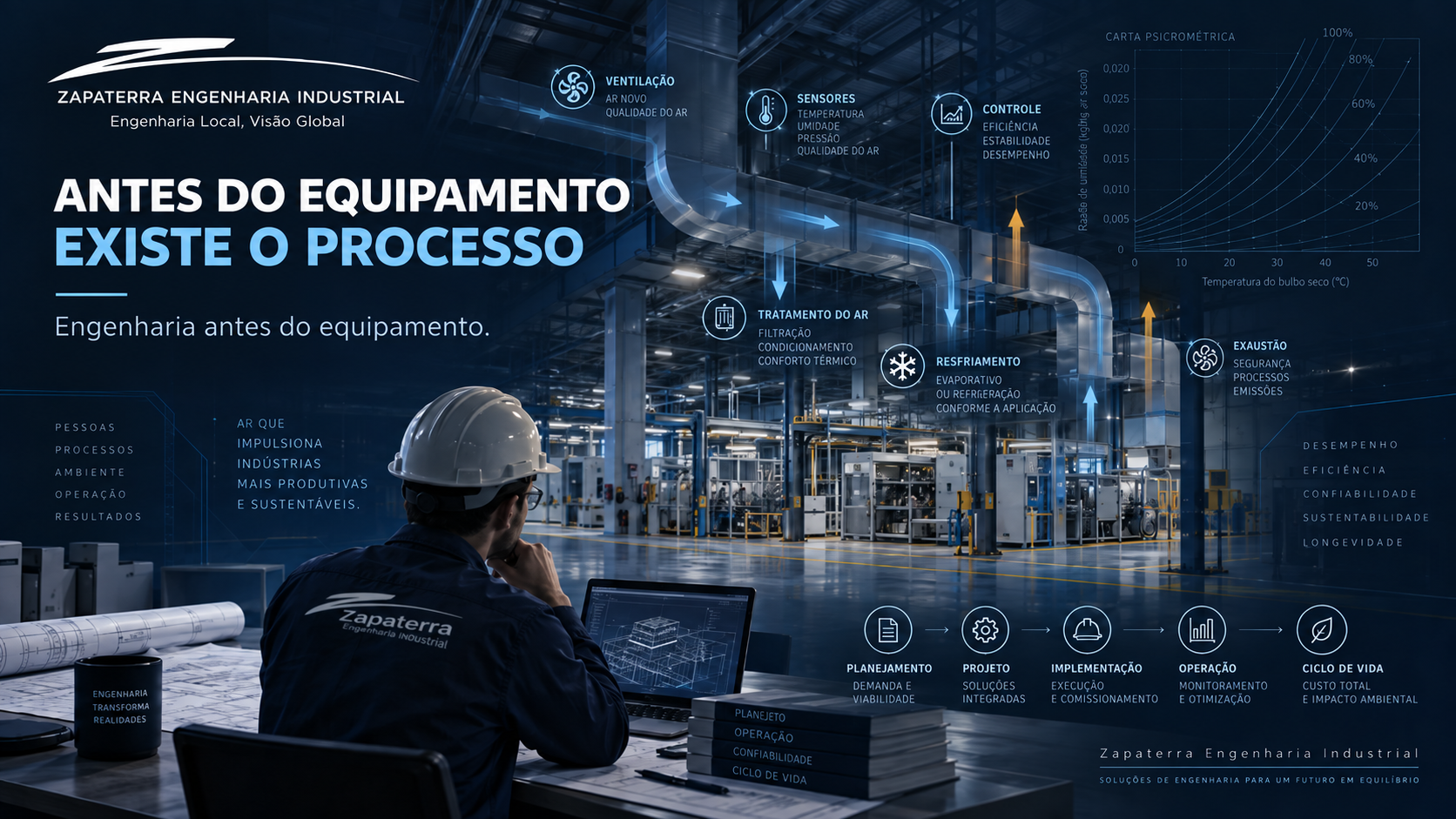
HVAC systems define more than temperature or thermal comfort. In an industrial installation, they can affect process conditions, productivity, energy consumption, environmental quality, maintenance, and the reliability of the operation itself.
For this reason, treating air conditioning, ventilation, exhaust, or outdoor-air renewal simply as an equipment purchase reduces an engineering decision whose consequences will remain present long after the installation has been completed.
The problem often begins when the question appears in the wrong order. A need for air conditioning arises and the immediate response is to look for a machine capable of meeting it. Capacities, prices, manufacturers, and commercial conditions are compared. All of these will matter at some point, but none of them should come before a more fundamental question:
What, exactly, do we need to do with the air?
Answering that question correctly changes the entire reasoning process. Before selecting equipment, it is necessary to understand the existing condition, define the condition that must be achieved, and identify which physical transformations will be required to produce that result.
Temperature, humidity, thermal load, outdoor-air renewal, exhaust, contaminants, pressure relationships between spaces, operating regime, and process characteristics then stop being isolated data and begin to form an engineering problem.
The psychrometric chart as a map
Perhaps one of the clearest ways to understand this logic is to see the psychrometric chart as a map. It allows us to identify where we are, where we need to go, and which thermodynamic paths can take us from one condition to another.
Heating, cooling, humidifying, dehumidifying, or combining these processes stops being merely a collection of available technologies and begins to represent different ways of producing a required physical transformation.
This perspective is important because installations that appear similar may require completely different paths. One environment may require only a reduction in temperature; another may require simultaneous cooling and dehumidification.
In one application, outdoor conditions may make evaporative cooling extremely appropriate. In another, adding moisture to the air may be exactly the opposite of what the process requires.
The technologies capable of producing these transformations already exist. Mechanical refrigeration, ventilation, exhaust, heating, humidification, evaporative cooling, and different combinations of these processes are well-known engineering resources.
The problem is not the absence of technological solutions. It is selecting a solution before properly understanding which transformation must be produced and under what conditions it will need to operate.
At this point, the psychrometric chart stops being merely a representation of air properties and also becomes an illustration of a way of thinking.
First, we understand where we are. Then we establish where we need to go. Next, we identify the process required to travel that path. Only then does it make sense to select the technology, size its components, and define the architecture capable of producing and sustaining that condition.
But defining the psychrometric path still does not mean that the entire system has been defined. The chart helps us understand the thermodynamic transformations of the air, but an industrial HVAC installation must also respond to issues that cannot be represented exclusively within it.
This is precisely where the problem definitively stops being a machine-selection exercise and begins to require a systemic view.
From the thermodynamic process to the system
Airflows, outdoor-air renewal, exhaust, distribution, contaminants, pressurization, operating regime, redundancy, maintenance, accessibility, and control must be considered together.
A change in airflow modifies pressure losses. A change in the amount of outdoor air affects the thermal load. An exhaust system changes air balances and internal pressure relationships.
Likewise, changes in the production process may introduce heat, moisture, or contaminants capable of altering the very conditions that originated the design.
This explains why HVAC should rarely be developed as a package independent from the industrial installation. It interacts with architecture, the production process, electrical systems, automation, utilities, maintenance, safety, and operation.
The later these interfaces are recognized, the greater the probability that the system will have to adapt to decisions that have already been made — when the more technically consistent approach would have been to coordinate those decisions from the beginning.
This is where many issues that later appear to be “construction problems” actually begin to be created.
Ducts need to cross areas where space has already been occupied. Equipment is installed without adequate access. Control systems begin compensating for difficulties created during conception, and adjustments made in the field become permanently incorporated into the installation.
The system may work. But working does not necessarily mean operating in a stable, efficient, and predictable manner.
This distinction deserves attention because an HVAC system should not be evaluated only by its ability to start, produce cooling, or move air.
The more important question is whether it can maintain, under the different real operating conditions, what was established as the design condition.
And to answer that question, it is necessary to return to the assumptions that gave rise to the system.
The right equipment can be in the wrong application
Excellent equipment can be inserted into an inadequate concept and will still remain part of an inadequate concept.
Likewise, equipment with excellent nominal efficiency does not, by itself, guarantee an efficient installation if it is sized, controlled, or applied outside the conditions under which it should operate.
This distinction also helps avoid misleading comparisons between technologies. Evaporative cooling is not inherently better or worse than mechanical refrigeration. Ventilation does not replace air conditioning in every situation, just as air conditioning does not automatically eliminate the need for ventilation or exhaust.
They are different processes, capable of responding to different physical and operational needs.
The essential question, therefore, is not to defend a particular technology, but to know how to apply it.
A solution may be technically excellent within the scenario for which it was conceived and inappropriate when transferred to another problem.
That is why engineering does not begin with the designer’s preference, the supplier’s availability, or the equipment with the most attractive commercial argument.
It begins with the correct interpretation of the need.
When this sequence is respected, technology begins to occupy its proper place in the project. It does not define the problem; the correctly understood problem determines which technologies make sense.
And this apparently simple inversion changes not only the initial sizing, but also what will happen throughout the entire service life of the system.
The decision continues after installation
When construction ends, the system begins its real life. And it is during this phase that decisions made during design begin to repeat themselves every day.
Energy efficiency, filtration, cleaning, accessibility, spare-parts availability, redundancy, balancing, automation, and behavior under different weather conditions stop being criteria recorded in documents and become part of the company’s operational routine.
Poor maintenance access will remain inadequate at every intervention. An improperly sized system will continue responding to load variations according to what its design allows.
An inadequate control strategy will repeat the same logic every day. In the same way, a correctly conceived solution will continue producing benefits with the same recurrence.
This is why the choice of an HVAC system does not end when the installation is delivered. It accompanies the asset for years and, in many cases, for decades.
Decisions made during design become permanent operating conditions.
This is also where the economic discussion naturally appears. Evaluating a solution only by its initial investment provides an incomplete view, because energy, maintenance, availability, reliability, and possible performance losses will continue to exist throughout the operating life of the system.
The relationship between CAPEX and OPEX deserves its own discussion, but there is an earlier conclusion:
The quality of operation begins with the quality of the decision made during design.
Procurement should be a consequence of engineering
A good HVAC system, therefore, is not simply the sum of good equipment.
It results from a coherent sequence of decisions: understanding the need, establishing assumptions, defining design conditions, identifying the required processes, determining airflows and loads, understanding interfaces, establishing control strategies, anticipating maintenance, and defining how performance will later be verified.
Only after this structure is sufficiently clear does equipment selection begin to make sense.
At that point, manufacturer, capacity, efficiency, construction characteristics, and cost stop being parameters analyzed in isolation and begin to be evaluated in relation to a previously defined function.
This sequence reduces improvisation because it turns procurement into a consequence of engineering, rather than turning engineering into a later justification for what has already been purchased.
The equipment remains essential, but it begins to occupy the correct place within the decision: it is a means of producing a previously established engineering condition.
This reasoning also creates a natural connection between design and commissioning.
If we know which conditions the system must produce, under which assumptions it was sized, and how it should respond to different operating conditions, we can later verify whether what was conceived was actually achieved.
The project stops ending at the drawing and begins to establish criteria for evaluating its own result.
Before asking how much it costs, we need to know what needs to be done
The question “How much does it cost to install?” is legitimate and will inevitably have to be answered.
But perhaps it should not be the first question.
Before it, there are more fundamental questions: What must this system guarantee? Under which conditions must it do so? How do those conditions vary during operation? Which interfaces must be preserved? And how will we later know whether what was designed actually happened?
When these questions are answered in the correct order, a consistent line of reasoning begins to emerge.
The need establishes the assumptions. The assumptions guide the processes. The processes lead to the system architecture. The architecture defines equipment, controls, and interfaces.
And all of this establishes the conditions that can later be verified during commissioning and monitored throughout operation.
Perhaps this sequence is precisely what distinguishes an installation that was simply executed from one that was effectively conceived to operate well.
It is not about making the project unnecessarily complex.
It is about resolving the complexity that already exists before it is transferred to execution, maintenance, or to those who will have to live with the installation during the years that follow.
That is why HVAC should not be treated merely as a construction stage or as a purchase to be resolved after all the other decisions have already been made.
Before the equipment, there is the process. Before the process, there is an understanding of the problem.
And perhaps that is precisely where a good HVAC design begins.
At Zapaterra, engineering is built from understanding the problem, defining assumptions and criteria, and integrating design, execution, and operation — seeking to reduce uncertainty and make technical decisions clearer, traceable, and verifiable.
Eng. Cássio Zapaterra
Technical Director — CREA 0682103339